
Fun-Duh-Mentals
Iterative system for generating curiosity, concrete knowledge and deep intuition about a field

Over the last couple of years, I have spent a lot of time studying mnemonics, memory techniques, how we learn, and how people build understanding across different areas of knowledge.
The influences are difficult to disentangle. They include:
Barbara Oakley and Terrence Sejnowski’s Learning How to Learn course on Coursera,
Peter C. Brown, Henry L. Roediger III, and Mark A. McDaniel’s Make It Stick,
James Clear’s Atomic Habits,
Charles Duhigg’s The Power of Habit,
Marek Szurawski’s Pamięć. Trening interaktywny (Memory, Interactive Training),
and the educational work of Benjamin Keep and Justin Sung on YouTube.
I cannot give specific credit for the model below to any one of them. It is closer to a synthesis of my own learning style and method after years of exposure to these different ideas.
Eventually, that synthesis compressed into a simple mnemonic:
FUN. DA (DUH). MENTALS.
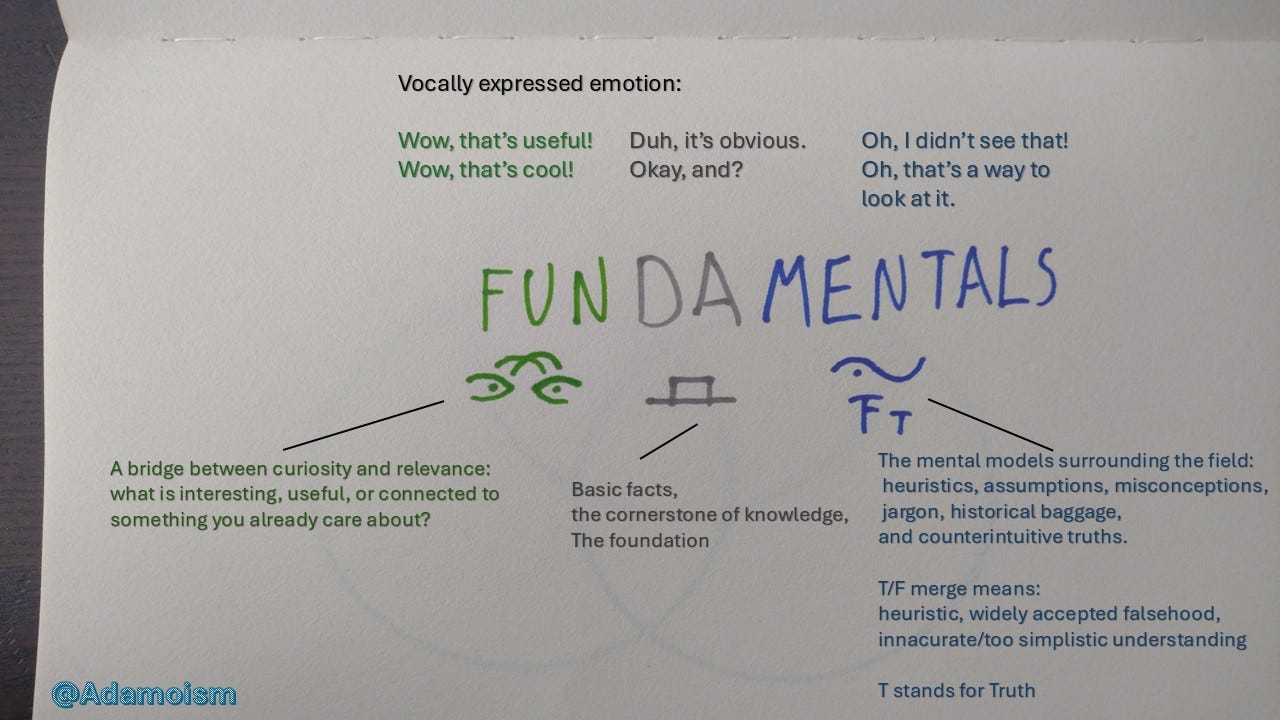
It points to three areas I repeatedly return to when trying to understand a new field:
FUN: curiosity, interest, and a feeling of applicability.
DUH: the obvious, basic, foundational facts.
MENTALS: the mental models surrounding a field: misconceptions, heuristics, assumptions, jargon, historical development, and counterintuitive truths.
I do not claim that these are the only ingredients of learning, or that Fun-Duh-Mentals is a scientifically validated model.
It is a useful heuristic for directing attention: a way to build a better map of an unfamiliar field.
And it is meant to be iterative.
You do not finish FUN, graduate to DUH, and eventually arrive at MENTALS. You move within each area and between all three.
Curiosity leads you toward facts. Facts generate better questions. Misconceptions expose gaps in your foundations. Historical developments reveal why today’s categories look the way they do. Better understanding produces more interesting questions.
A good learning session should generate the question that begins the next one.
FUN: Find an entrance
To learn something voluntarily, it helps to have a reason to care.
Sometimes that comes from intrinsic curiosity: this is strange; I want to understand it.
Sometimes it comes from perceived usefulness: this could help me solve a problem I already care about.
Those are not the only possible sources of motivation, but curiosity is particularly relevant here. Experimental work by Gruber and colleagues found that people remembered information better when they were in states of high curiosity, and later theoretical work connected curiosity with information-seeking and memory processes (Gruber, Gelman, & Ranganath, 2014; Gruber & Ranganath, 2019). (PubMed Central (PMC))
The practical implication I take from this is not simply:
Make learning fun.
It is:
Find the lens through which the subject becomes interesting to you.
Imagine someone who likes history but hates chemistry.
The default solution is to begin teaching chemistry directly: atoms, elements, bonds, equations.
But perhaps the better entrance is historical.
How did alchemy become chemistry?
Why did people believe in phlogiston?
What problem was Mendeleev trying to solve?
Which discoveries forced chemists to abandon older pictures of matter/substance?
Nothing about chemistry itself has changed. What changed is the lens.
The same subject could be entered through medicine, economics, cooking, warfare, environmental science, philosophy, engineering, or almost anything else the learner already finds interesting:
Someone interested in medicine might approach chemistry through pharmacology.
Someone interested in economics might begin with fertilizers, oil, or industrial chemistry.
Someone interested in philosophy might begin with the changing idea of what “matter” actually is.
Someone interested in cooking can begin with acids, proteins, emulsions, and heat.
FUN therefore becomes an iterative search:
existing interest → analogy or lens → curiosity question → narrower curiosity question → new connection
The important thing is scope.
Instead of asking:
How can I become interested in chemistry?
ask:
Which topic in this chapter looks most interesting to me?
Then:
What is one thing about it I genuinely want to understand?
You do not need enough curiosity to love an entire discipline.
You need enough curiosity to pull on one thread.
FUN asks: What would make me want to know one thing more?
The green part of the diagram is the meeting point between curiosity and relevance: that is interesting and that could be useful.
The point is not to wait passively for either feeling. You can search for the perspective that creates it.
DUH: Build from first principles
Every field contains things practitioners eventually find so basic that they stop noticing them.
Definitions.
Basic mechanisms.
Core distinctions.
Foundational vocabulary.
The ground facts on which everything else rests.
Call them first principles, fundamentals, or simply the things that make an expert say:
“Well... duh.”
These ideas can be deceptively boring to a beginner, precisely because their importance only becomes obvious after you know enough to see what depends on them.
But you need a foundation to contextualize more advanced information correctly.
Research syntheses from the National Academies emphasize that new learning is shaped by prior knowledge and that expert understanding involves knowledge organized around important concepts rather than a disconnected collection of facts (National Research Council, 2000; National Research Council, 2002). (National Academies)
So DUH is not simply:
Learn the basics.
It is another iterative process:
basic fact → relationship → mechanism → more complex fact → integration
Suppose our history-loving chemistry beginner becomes interested in the periodic table.
Instead of jumping randomly through videos and articles, they might ask:
What five ideas do I need to understand before I can understand why the periodic table works?
Perhaps the path becomes:
elements → atoms → atomic number → electron structure → periodic trends
Each concept makes the next one easier to place.
This is also where FUN and DUH reinforce each other.
Interesting facts can motivate you to learn foundations.
Foundations make previously incomprehensible facts interesting.
Something that initially produces “Okay, and?” can later produce “Oh, that explains it.”
DUH asks: What can I not afford to misunderstand if I want the next idea to make sense?
MENTALS: Learn to see the filters
This is the part of the framework I find most interesting.
Knowing the facts of a field is not the same as having good intuition about it.
We interpret facts through mental machinery:
heuristics,
assumptions,
categories,
analogies,
jargon,
historical baggage,
simplifications,
and stories about how things work.
The problem is that we usually do not see our filters.
We see through them.
One way to make those filters visible is to study where they fail.
What do outsiders usually misunderstand?
What does popular media repeatedly get wrong?
What beginner misconception keeps appearing?
Which shortcuts do practitioners use?
When do those shortcuts fail?
Which concepts are routinely oversimplified for teaching?
Which assumptions does the field itself take for granted?
And, eventually:
Which of today’s assumptions might a future version of the field abandon?
This progression matters because misconceptions are not always isolated wrong facts. A learner can have an underlying conceptual framework that generates the wrong answer repeatedly. Educational research has therefore emphasized that some misconceptions require restructuring the surrounding conceptual model rather than merely replacing one statement with another (National Research Council, 2002). (National Academies)
So a mistake can be unusually informative.
It tells you not only what is wrong, but sometimes which intuition generated the error.
I think of MENTALS as another sequence of levels:
outsider assumption → common misconception → practitioner heuristic → overused heuristic → internal disagreement → possible paradigm shift
Confidence should decrease as you move along that chain:
“Beginners often confuse X and Y” may be well established.
“Practitioners often use heuristic Z” may be reasonably documentable.
“This heuristic is overused” is already interpretation.
“This assumption will drive the next paradigm shift” is speculation.
That final stage should therefore be treated as a frontier question, not a prediction.
The purpose is to move from:
What do outsiders get wrong?
toward:
What do practitioners themselves simplify?
and finally:
What might the field currently be unable to see about itself?
Historical development is especially useful here.
History can belong to FUN when it becomes an attractive lens into a field.
But it can also belong to MENTALS when it reveals that something we treat as natural or obvious is partly the residue of an older theory, convention, technological limitation, or institutional habit.
MENTALS asks: Where does my intuition help me; and where is it likely to mislead me?
The circles feed one another
This is why I now think of Fun-Duh-Mentals less as three boxes and more as three overlapping loops.
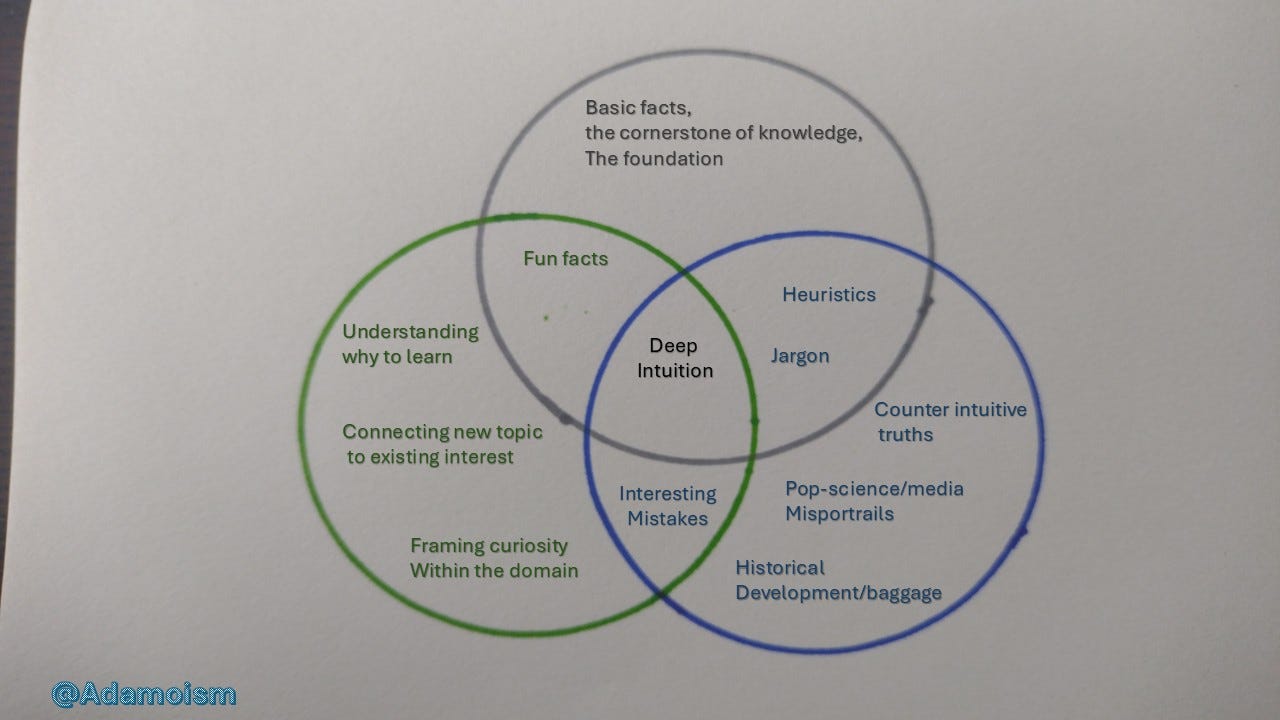
FUN + DUH can lead to fun facts: foundational knowledge that is inherently surprising.
FUN + MENTALS can point us towards interesting mistakes: misconceptions that become curiosity engines.
DUH + MENTALS contains things like jargon and heuristics: tools practitioners need, but which also influence how they perceive the field.
Historical development can move between FUN and MENTALS depending on how it is being used.
And in the center sits deep intuition.
I deliberately do not call it mastery.
Mastery requires more than a conceptual map. It requires practice, feedback, application, memory, correction, and time.
Brown, Roediger, and McDaniel emphasize retrieval, spacing, interleaving, and other forms of effortful practice as ways of making learning more durable and transferable (Brown, Roediger, & McDaniel, 2014). (Make It Stick)
Oakley and Sejnowski’s Learning How to Learn likewise covers memory, chunking, illusions of learning, procrastination, and evidence-informed approaches to learning difficult material (Oakley & Sejnowski, 2014). (Coursera)
Fun-Duh-Mentals does not replace those processes.
It helps decide what you should be trying to understand in the first place.
A 30-minute Fun-Duh-Mentals session
Suppose I know almost nothing about chemistry.
I have 30 minutes.
I dislike chemistry, but I like history.
Minutes 0–5: FUN
I begin by finding a lens.
What are three moments in the history of chemistry that fundamentally changed how people understood chemistry?
Suppose Mendeleev and the periodic table catch my attention.
I narrow the question:
What problem did the periodic table solve that chemists previously struggled with?
Now I am not attempting to “learn chemistry.”
I am following one live question.
Minutes 5–15: DUH
Next:
What five concepts do I need to understand before I can understand why the periodic table works? (In order from most foundational to most dependent.)
Perhaps that generates:
elements → atoms → atomic number → electron structure → periodicity.
I work upward.
Then I stop looking at the explanation and try to reconstruct the chain myself.
That last step matters because retrieval, not merely rereading, is one of the learning practices emphasized by Brown and colleagues (2014). (Make It Stick)
Minutes 15–25: MENTALS
Now I start attacking my model.
What do beginners commonly misunderstand about the periodic table?
Then:
What heuristic do chemists use when reasoning from the table?
Then:
Where does that heuristic break down or become too simplistic?
Then:
What current question or assumption about chemical organization is still debated?
And perhaps, carefully:
What kind of development could substantially change how chemists conceptualize this area?
I have moved from outsider misconceptions toward practitioner reasoning and finally toward the frontier.
The further I move, the more I should distinguish established knowledge from interpretation and speculation.
Minutes 25–30: LOOP
I close everything.
From memory, I write:
One thing that made me say “Wow.”
One thing that now feels “Duh.”
One thing that made me say “Oh—I was looking at that the wrong way.”
Then:
Which of these produces the best next question?
That becomes the starting point for session two.
A good learning session does not only produce answers. It produces better questions.
The framework is itself a Mental
There is an obvious irony here.
Fun-Duh-Mentals is itself a heuristic.
It simplifies reality.
Not every field has uncontested foundations. Practitioners disagree. Useful heuristics can become misleading. Something called a “misconception” may turn out to be a legitimate minority position. And asking for the “next paradigm shift” can easily produce a compelling story rather than a reliable forecast.
That is why the framework should generate research questions, not predetermined answers.
This matters particularly when using AI (and we all are - for better or worse).
Fun-Duh-Mental prompt
I have been turning Fun-Duh-Mentals into a prompt for a research-based AI teacher: one that first understands the learner, diagnoses their current knowledge, finds relevant lenses, establishes foundational facts, explores misconceptions and practitioner heuristics, and distinguishes established knowledge from disagreement, synthesis, and speculation.
I will share that prompt here.
But the prompt is only an implementation.
The model underneath it is simpler:
find an entrance → build the foundation → inspect the filters → generate a better question → repeat
And after years of experimenting with different approaches to learning, this is the pattern I keep returning to.
Final words
When I enter a new area of knowledge now, I look for three kinds of moments.
Something that makes me say:
“Wow, that’s useful.”
“Wow, that’s cool.”
Something that makes me say:
“Duh. It’s obvious.” (once I learn about it)
And something that makes me stop and say:
“Oh, I didn’t see that.”
“Oh, that’s a way to look at it.”
If I can keep producing all three, the subject gradually stops looking like a pile of information.
It starts becoming a map I can think with.
Have a good one,
Custodian of Adamoism
References
Brown, P. C., Roediger, H. L., III, & McDaniel, M. A. (2014). Make it stick: The science of successful learning. Harvard University Press. The authors’ companion site summarizes the book’s discussion of retrieval, spacing, interleaving, generation, and effortful learning. (Make It Stick)
Clear, J. (2018). Atomic habits: An easy & proven way to build good habits & break bad ones. Avery. Formative influence on my learning approach; not a source for the Fun-Duh-Mentals framework itself.
Duhigg, C. (2012). The power of habit: Why we do what we do in life and business. Random House. Formative influence; not a source for the framework itself.
Gruber, M. J., Gelman, B. D., & Ranganath, C. (2014). States of curiosity modulate hippocampus-dependent learning via the dopaminergic circuit. Neuron, 84(2), 486–496. (PubMed Central (PMC))
Gruber, M. J., & Ranganath, C. (2019). How curiosity enhances hippocampus-dependent memory: The Prediction, Appraisal, Curiosity, and Exploration (PACE) framework. Trends in Cognitive Sciences, 23(12), 1014–1025. (PubMed Central (PMC))
Keep, B. (n.d.). YouTube videos and educational work on learning and reasoning. Keep describes his work as cognitive science focused on learning, reasoning, teaching strategies, misconceptions about learning, research methods, and cognitive biases. Formative influence; not a source for the framework itself. (benjaminkeep.com)
National Research Council. (2000). How people learn: Brain, mind, experience, and school: Expanded edition. National Academies Press.
National Research Council. (2002). Learning and understanding: Improving advanced study of mathematics and science in U.S. high schools. National Academies Press. Its discussion of learning with understanding addresses prior knowledge, conceptual organization, and the need to reconstruct conceptual frameworks when misconceptions interfere with understanding. (National Academies)
Oakley, B., & Sejnowski, T. J. (2014–). Learning how to learn: Powerful mental tools to help you master tough subjects [Online course]. Coursera. The course covers focused and diffuse modes, chunking, memory, procrastination, illusions of learning, and learning techniques. (Coursera)
Sung, J. (n.d.). Educational work on learning and self-regulated learning [YouTube and iCanStudy]. Sung describes his work around learning science and self-regulated learning; his public material includes extensive YouTube instruction. Formative influence; not a source for the framework itself. (YouTube)
Szurawski, M. (various editions). Pamięć. Trening interaktywny. Cz. 1: 1000 słówek w 1000 minut, sukces w szkole i na uczelni, nowoczesne metody pamięciowe, rozwijanie inteligencji językowej, radość uczenia się. Aha!. An approximate English rendering is: Memory: Interactive Training. Part 1: 1,000 Words in 1,000 Minutes, Success at School and University, Modern Memory Techniques, Developing Verbal Intelligence, and the Joy of Learning. Formative influence; not a source for the framework itself.